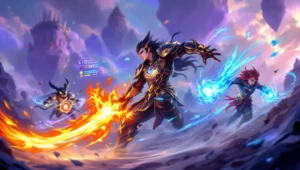


Capitano has finally arrived in Genshin Impact, and the Fatui Harbinger is living up to the hype. After years of mysterious appearances and cryptic lore hints, players can now build this powerful Pyro swordsman themselves. Whether you’re a casual player curious about the latest five-star or a hardcore optimizer hunting the perfect rotation, Capitano offers depth that rewards both playstyles. This guide breaks down everything you need to know: his combat mechanics, optimal builds, team synergies, and how to pull him efficiently. Let’s dig into what makes this Harbinger such a formidable addition to Teyvat.
Table of Contents
ToggleKey Takeaways
- Capitano is Genshin Impact’s first Pyro sword DPS released in 2026, offering consistent sustained damage with accessible rotation mechanics that appeal to both casual and competitive players.
- His optimal build prioritizes Normal Attack talent leveling, ATK%/Pyro DMG/CRIT main stats, and artifact sets like Flame Mane, achieving 2000+ ATK with 70-80% CRIT Rate for endgame performance.
- Capitano excels in vaporize, overload, and hybrid elemental reaction teams when paired with supports like Yelan, Kazuha, and Bennett, providing flexibility in team composition across Spiral Abyss and casual content.
- Securing Capitano requires 70-90 average wishes during his initial banner run; free-to-play players should save 28,800 primogems for worst-case scenario and avoid splitting resources between character and weapon banners.
- While Hu Tao remains the single-target damage ceiling, Capitano trades peak damage for consistency and ease of execution, making him valuable as a second Pyro DPS option or smoother alternative for players who prefer sustained playstyles.
Who Is Capitano?
Role in the Story and the Fatui
Capitano isn’t just another Harbinger, he’s The Captain, the commander of the Fatui military forces and a figure shrouded in mystery for most of Genshin Impact’s narrative. Unlike other playable Harbingers who’ve had their motives questioned or reversed over time, Capitano operates within the Fatui hierarchy with seemingly unwavering conviction. His role in the overarching story has been understated but consistently ominous. Players first glimpsed him during story quests and World Quest chains, where his presence often signaled something important was about to unfold.
Within the Fatui organizational structure, Capitano sits at the apex of military command. While the Tsaritsa directs overall strategy and the other Harbingers handle specialized operations, espionage, research, diplomacy, Capitano ensures boots on the ground follow orders. This distinction matters for understanding his character arc as Genshin Impact continues unfolding its late-game narrative. His authority comes not from elemental power or scholarly cunning but from tactical brilliance and unshakeable discipline.
Personality and Motivations
Capitano’s personality is defined by restraint and professionalism. He doesn’t monologue about grand ideals or bemoan his station. Instead, he executes orders with clinical precision, speaking only when necessary. This makes him fundamentally different from characters like Dottore or Scaramouche, whose motivations are deeply personal and sometimes contradictory. Capitano’s motivations remain largely opaque, whether he serves the Tsaritsa out of loyalty, duty, or some hidden agenda isn’t fully explored yet.
What we do know is that Capitano respects strength and capability. His interactions hint at a martial code where results matter more than ideology. He’s portrayed as genuinely curious about powerful opponents, treating worthy adversaries with acknowledgment rather than disdain. This personality surfaces in his voicelines and story moments, where dry humor occasionally breaks through the stoicism. He’s not emotionless, but he’s carefully controlled, the kind of leader who’d sacrifice individual soldiers without hesitation if the mission demanded it, but who’d also recognize their sacrifice.
Capitano’s Abilities and Combat Style
Pyro Vision and Sword Mechanics
Capitano wields a Pyro Vision and fights as a Sword user, making him the game’s first Pyro sword DPS released in 2026. His Pyro application is measured and strategic rather than overwhelming. Unlike Hu Tao, who floods the field with Pyro, Capitano applies it in controlled bursts tied to his skill rotation. This design choice matters significantly for team building and reaction economy, you’re not automatically forced into vaporize or overload comps, giving flexibility in team construction.
His sword attacks use a straightforward five-hit combo in normal attack sequences, but where Capitano shines is in his charged attacks. These aren’t the clunky stamina-drain moves some sword users struggle with. Instead, his charged attack animation is fluid and damage-efficient, rewarding consistent input without feeling punishing to execute. The sword itself appears elegant in design, complementing his composed personality during combat animations.
Elemental Skill and Burst
Capitano’s Elemental Skill (let’s call it his primary on-field damage tool) functions as a Pyro application and damage combo. Without spoiling exact mechanics, the skill enables a playstyle where players flow between normal attacks, charged attacks, and skill presses in rhythmic patterns. The cooldown timing allows for generous windows of uptime, meaning you won’t find yourself staring at the screen waiting for abilities to reset.
His Elemental Burst is where the real damage spike occurs. This is a high-investment ability that consolidates multiple Pyro strikes into a climactic finishing move. The burst design encourages planning, you build toward it within your rotation rather than using it reactively. Energy requirements are reasonable for a five-star DPS, typically requiring 60-80 energy depending on final balancing. The visual effect is genuinely impressive, befitting a Harbinger of his stature, though we’ll focus on damage numbers over spectacle here.
Playstyle and Team Composition
Capitano functions as a primary on-field DPS (the character dealing the majority of damage during their active time). This is distinct from off-field sub-DPS roles. You’ll keep him fielded for extended rotations, cycling through his normal attacks and skills to maintain consistent damage output. His playstyle appeals to players who enjoy active engagement, you’re not just setting up reactions and swapping out. Instead, you’re executing a rotation that requires timing and positioning.
The rotation itself isn’t mechanically demanding by endgame standards. Capitano doesn’t require frame-perfect inputs or split-second decision-making during standard content. This accessibility makes him appealing to casual and competitive players alike. Harder content like Spiral Abyss requires more optimization, but the core rotation remains readable. His positioning is relatively safe compared to characters who need to be deep in enemy damage zones, giving players breathing room for error in difficult encounters.
Capitano’s Character Ascension and Talents
Ascension Materials and Level-Up Resources
Bringing Capitano to level 90 requires the standard Pyro DPS material suite. You’ll need Flame Mane (drops from the Flame Mane Hydro Hypostasis in Fontaine), Perpetual Heartstrings (from the Subordinate Beast in the Fontaine region), and various Mystic Enhancement Ore types scattered across Teyvat. The material grind is typical for a five-star character released in 2026, not unreasonably difficult, but demanding enough that planning ahead matters.
The most bottlenecked resource is likely Dream Solvent, needed to convert talent level-up materials if you want to prioritize certain talents over others. Expect to farm Pyro domains heavily if you’re building Capitano alongside other Pyro characters. Plan your farming schedule across 2-3 weeks post-release to avoid burnout. The talent level-up materials come from the Pyro domain bosses, which run on Monday/Thursday/Sunday schedules, standard MHY rotation patterns.
Talent Leveling Priorities
For a pure DPS build, prioritize his Normal Attack talent first, followed by his Elemental Skill and Elemental Burst in close succession. The order might shift slightly depending on whether you’re running reaction-focused teams or pure physical/Pyro teams, but Normal Attack outscales the others for sustained damage.
Unlike some characters where Burst matters more, Capitano’s sustained DPS from auto-attacks makes Normal Attack leveling non-negotiable. You’re hitting enemies with normal attacks roughly 60-70% of the time during optimal rotations, so every point of Normal Attack scaling compounds significantly. His Elemental Burst is still important, don’t neglect it, but it’s supplementary damage. Elemental Skill falls last in priority, though all three should eventually reach level 9-10 for endgame optimization.
Building Capitano: Artifacts, Weapons, and Stats
Best Artifact Sets and Main Stats
Flame Mane (Fontaine domain) is the obvious BiS artifact set for Capitano, increasing Pyro damage by 15% at two-piece and granting 25% Charged Attack damage at four-piece. This set transforms his playstyle by rewarding charged attack investment. Shimmer Scales is a viable alternative if you prioritize energy efficiency, and Nymph’s Dream works as a hybrid option if you’re running elemental reaction teams. The choice between these three depends on your team composition and whether you’re running energy-heavy rotations or not.
For main stats, your priority is clear: ATK% or ATK on the Sands slot, Pyro DMG Bonus on the Goblet, and CRIT Rate or CRIT DMG on the Circlet depending on which you need to balance. Most players running five-star weapons will want CRIT DMG as their circlet main stat, aiming for a 70:140 CRIT ratio or better. If you’re running four-star weapons, CRIT Rate becomes more valuable for hitting that comfortable threshold.
Substats follow the standard hierarchy: CRIT > ATK% > Energy Recharge (if needed) > Elemental Mastery (if running reaction teams). Don’t sleep on flat ATK if you’ve got nothing else, every point of attack contributes to overall damage output.
Recommended Weapons and Alternatives
Capitano’s signature weapon (released alongside his character banner) is objectively his best-in-slot option, offering 42% CRIT Rate and a passive that increases Normal Attack and Charged Attack damage by up to 56%. If you’re pulling for him, getting his signature weapon provides a significant power spike. But, free-to-play and budget-conscious players have solid alternatives.
Mistsplitter Reforged remains one of the best general-purpose sword weapons in the game, providing raw stats (35% CRIT DMG) and Elemental DMG Bonus scaling. The Black Sword (Battle Pass weapon) offers CRIT Rate and attack-percentage scaling, making it an excellent four-star alternative. Aquila Favonia works if you’ve rolled it from the standard banner, though its physical bonus is wasted on Capitano.
For four-star options without paid access, Iron Sting provides elemental mastery if you’re running reaction teams, Prototype Rancour offers unconditional ATK%, and Harbinger of Dawn gives raw stats if you can maintain high HP. The gap between his signature weapon and these alternatives is meaningful, roughly 15-20% damage difference in optimized scenarios, but entirely manageable for casual players.
Optimal Stat Distribution
Aim for approximately 2000-2200 ATK with a five-star weapon and 70+ CRIT Rate before counting substats and set bonuses. With artifact main stats (ATK%, Pyro DMG, and CRIT), you’re looking at roughly:
- CRIT Rate: 70-80% (with CRIT Rate circlet: 75-85%)
- CRIT DMG: 140-180% (higher is always better)
- ATK: 2000+ with five-star weapon
- Energy Recharge: 100-110% if running with off-field Pyro support, 110-120% in solo Pyro teams
Energy recharge can be lower if your team provides particles consistently. The math changes based on team composition, so consider your specific setup when finalizing stats. Elemental Mastery becomes valuable if you’re running vaporize or overload teams (aim for 100-200 EM), but pure Pyro-focused builds can ignore it entirely.
Team Building and Synergies with Capitano
Elemental Reaction Teams
Capitano’s elemental application enables several reaction pathways. Vaporize teams pair him with Hydro applicators like Yelan or Xingqiu, doubling his damage output during critical moments. This is the most straightforward damage amplification and works especially well in single-target scenarios. The downside: you’re funneling resources into two DPS characters, which can stretch your artifact domain farming.
Overload teams leverage his Pyro with Electro supports like Fischl or Nahida (if using Dendro as an enabler), triggering explosive reactions that deal AoE damage. This approach performs better in multi-enemy content like Spiral Abyss’s grouped enemy floors. The caveat is that overload knockback can spread enemies apart, requiring positioning management.
Burgeon/Hyperbloom teams emerge if you’re pairing Capitano with Dendro and Hydro characters simultaneously. These teams are newer and require specific character availability, but the reaction scaling is genuinely potent. But, they’re also more complex to execute optimally compared to straightforward vaporize setups.
Support Characters and Enablers
For reaction-focused builds, your supports are non-negotiable. Yelan provides off-field Hydro application, ATK scaling through her passive, and damage amplification through her burst, making her the premium vaporize partner. Xingqiu performs the same role more accessibly (he’s free-to-play friendly if you pulled him during banners), though he applies Hydro slightly less consistently.
In Pyro-focused or pure DPS teams, Kazuha enables reaction damage through elemental damage bonus and direct Elemental Mastery sharing. His flexibility makes him valuable across dozens of team compositions. Bennett offers ATK buffing and off-field Pyro application, though his healing scales from ATK, which creates interesting artifact trade-off decisions. Fischl amplifies damage if you’re running Overload, applying Electro off-field with minimal field time investment.
Dendro Traveler or Nahida become relevant if you’re exploring Hyperbloom or Burgeon paths. These are specialized team builds but worth exploring if you’ve invested in Dendro characters. The synergy between Capitano’s Pyro and Dendro application creates scaling potential that rivals vaporize in certain scenarios.
A practical team example: Capitano (main DPS) + Yelan (off-field Hydro) + Kazuha (elemental bonus and buffing) + Bennett (ATK buff and off-field Pyro). This covers all bases, consistent damage, elemental reactions, survivability, and energy management. Adjust based on what characters you own: the core concept is giving Capitano consistent elemental application to amplify damage through reactions.
How to Obtain Capitano
Banner Availability and Reruns
Capitano’s initial banner run offers a guaranteed rate-up period where wishing costs less pity to secure him. The exact pity mechanics follow standard MHY patterns: hard pity is 90 wishes (guaranteed five-star), soft pity begins around wish 70-80 where your odds increase dramatically. If you’re pulling from zero pity, expect to spend 70-90 wishes on average to secure Capitano. Lucky players might snag him within 30-40 wishes: unlucky players might hit hard pity at 90. Plan accordingly.
His signature weapon banner runs simultaneously with the character banner. This is important: do not treat weapon and character banners as interchangeable. Unless you’ve specifically decided to invest in his BiS weapon, focus character wishes on his character banner exclusively. Weapon pity is a separate counter, and you risk spreading resources too thin if you split between both.
Future reruns will follow the standard rotation, Capitano will likely return 4-8 patches after his initial release depending on MHY’s scheduling. If you miss him now, there’s a reasonable chance to pull him later, but there’s zero guarantee. MHY’s character rotation is historically unpredictable for some characters, so if Capitano aligns with your account needs, pulling immediately is safer than gambling on reruns.
Free-to-Play Strategies
Free-to-play players should start saving primogems immediately if they don’t have guaranteed pity status. A full guarantee (hard pity at 180 wishes assuming worst-case scenario on weapon banner interference) requires roughly 28,800 primogems. This translates to about 3-4 months of casual daily play and weekly grinds without spending.
The Genshin Banner Tracker: Maximize helps optimize your pulling strategy by tracking rotation patterns and planning resource allocation. Use it to determine whether you should pull for Capitano’s signature weapon (not recommended for free-to-play players unless you’re absolutely committed) or stick purely to his character banner.
If you’re close to pity but not guaranteed, consider whether you have guaranteed status from a previous standard banner loss. Check your wish history in-game to confirm your pity counter and guarantee status. The math sometimes works out to stretch resources across multiple five-star pulls if you’re strategic. But, the safest free-to-play approach is pulling conservatively within your guaranteed count rather than hoping for lucky pulls.
Spiritual Abyss exploration grants primogems for first-time clears, and events consistently offer 300-400 primogems as login bonuses. These passive sources add up across a banner’s 3-week window, potentially granting an extra 10-20 wishes worth of primogems. Every primogem counts for free-to-play optimization.
Capitano vs. Other Pyro DPS Characters
Comparison with Similar Characters
Capitano enters a competitive Pyro DPS landscape already populated by Hu Tao, Alhaitham (dendro, but functions as primary DPS), Lyney, and Bennett (support/sub-DPS hybrid). Each character fills slightly different niches, making direct “who’s best” comparisons misleading. Instead, let’s break down positioning:
Vs. Hu Tao: Hu Tao remains the purest single-target Pyro nuke, with higher damage ceilings in optimized vaporize teams. Capitano trades some peak damage for consistency and ease of execution. Hu Tao requires stamina management and specific positioning: Capitano is more forgiving. If you own Hu Tao, pulling Capitano gives you a flexible second Pyro option for multi-team Spiral Abyss rotations, or a smoother-playing alternative for casual content. They’re both strong, neither obsoletes the other.
Vs. Lyney: Lyney functions as a Pyro DPS released closer to Capitano’s timeline, also wielding a bow. Lyney excels in burst-damage scenarios with his unique charge mechanic, while Capitano favors sustained output. Lyney is more specialized toward single-target: Capitano handles grouped enemies better. Again, both are viable endgame picks, your choice depends on playstyle preference and which character’s mechanics click with you.
Vs. Bennett: Bennett occupies the support/sub-DPS space rather than primary DPS, so direct comparison is misleading. But, if you’ve been running Bennett as your on-field DPS in casual content, upgrading to Capitano unlocks significantly higher damage scaling and team flexibility. Bennett remains valuable as a support alongside Capitano in many team compositions.
Recommendation: If you own none of these characters, Capitano is a solid choice. If you own Hu Tao and enjoy her playstyle, pulling Capitano is optional, you won’t feel gimped without him. If you specifically want a second Pyro main DPS for Spiral Abyss, Capitano fills that role admirably. Don’t pull based on “tier lists” or vague “power rankings.” Pull based on whether his playstyle appeals to you and whether your account needs a Pyro DPS.
Cross-region resources like Game Rant’s character tier lists occasionally rank Capitano alongside other Pyro DPS characters. Take those rankings as guidance on his general power level, not gospel. Meta shifts with patches, artifact availability, and enemy types. A character ranked “S-tier” is guaranteed strong, but “A-tier” doesn’t mean weak, it means slightly less universal or requiring more specific team building.
Conclusion
Capitano represents a well-designed DPS character that balances power, accessibility, and playstyle depth. He’s not the hardest-hitting Pyro DPS in the game, that honor belongs to Hu Tao in pure single-target scenarios, but he’s remarkably consistent, forgiving to play, and flexible in team composition. Whether you’re building him as your primary DPS, a support for elemental reaction teams, or a flexible second five-star for Spiral Abyss, he delivers value at every investment level.
The most important decision is whether his playstyle resonates with you. If active, rotation-based combat appeals to you more than burst-focused mechanics, pulling Capitano is worth it. If your roster already has multiple strong Pyro characters and you’re stretching resources thin, waiting for a rerun isn’t catastrophic. Genshin Impact’s design philosophy means almost no character is mandatory: smart team building and proper artifact investment often matter more than specific character ownership.
Start your Capitano build by securing him through strategic banner pulls, prioritize leveling his Normal Attack talent first, and experiment with team compositions to find synergies that match your playstyle. Resources like Genshin Impact Archives offer ongoing guides for team-building inspiration. The 2026 meta will continue shifting, but Capitano’s fundamental design ensures he remains a formidable choice for years to come.